Skip to product information
1 of 5

Dual Stage Amplification

Tiger Buffer MK1

Tiger Buffer MK1

Regular price $99.99 USD
Regular price Sale price $99.99 USD
Sale Sold out
Shipping calculated at checkout.

Every note arrives the way it left.

Quantity

Only 5 left in this batch

  • Hand-built in New Haven, CT
  • Ships in 1–3 business days
  • Limited lifetime warranty

Somewhere between your guitar and everything else, a little of the signal slips away — some top end here, a little life there. The Tiger Buffer quietly keeps it whole.

It follows the unity-gain buffer Jerry Garcia carried inside his Doug Irwin “Tiger” — the quiet reason his tone stayed clear and present through effects, long cable runs, and very long nights. Sit it first in your chain and it simply takes what your guitar gives it and passes it on, untouched. Every night, every note, the same.

Under the hood, this is John Cutler's design — the circuit itself — built with modern low-noise components chosen to hold their spec instead of drifting with age. Where the original ran an LF356, the Tiger Buffer runs a TL061: on our bench it handled pickup transients even more gracefully than the classic chip, and its very low current draw makes it ideally suited to OBEL rigs.

No knobs. No switches. Nothing to set and nothing to remember — just a prowling tiger burned into the wood, doing three milliamps of quiet, honest work.

Handmade in New Haven, CT.

Specifications

  • Circuit: John Cutler's Tiger unity-gain buffer design
  • Op-amp: TL061 JFET-input — handled pickup transients better than the original-spec LF356 in our testing
  • Components: modern low-noise, selected not to drift with age
  • Type: always-on — no knobs, no footswitch
  • Current draw: 3mA
  • Power: 9V DC center-negative, 2.1mm barrel — no battery (designed for 9V)
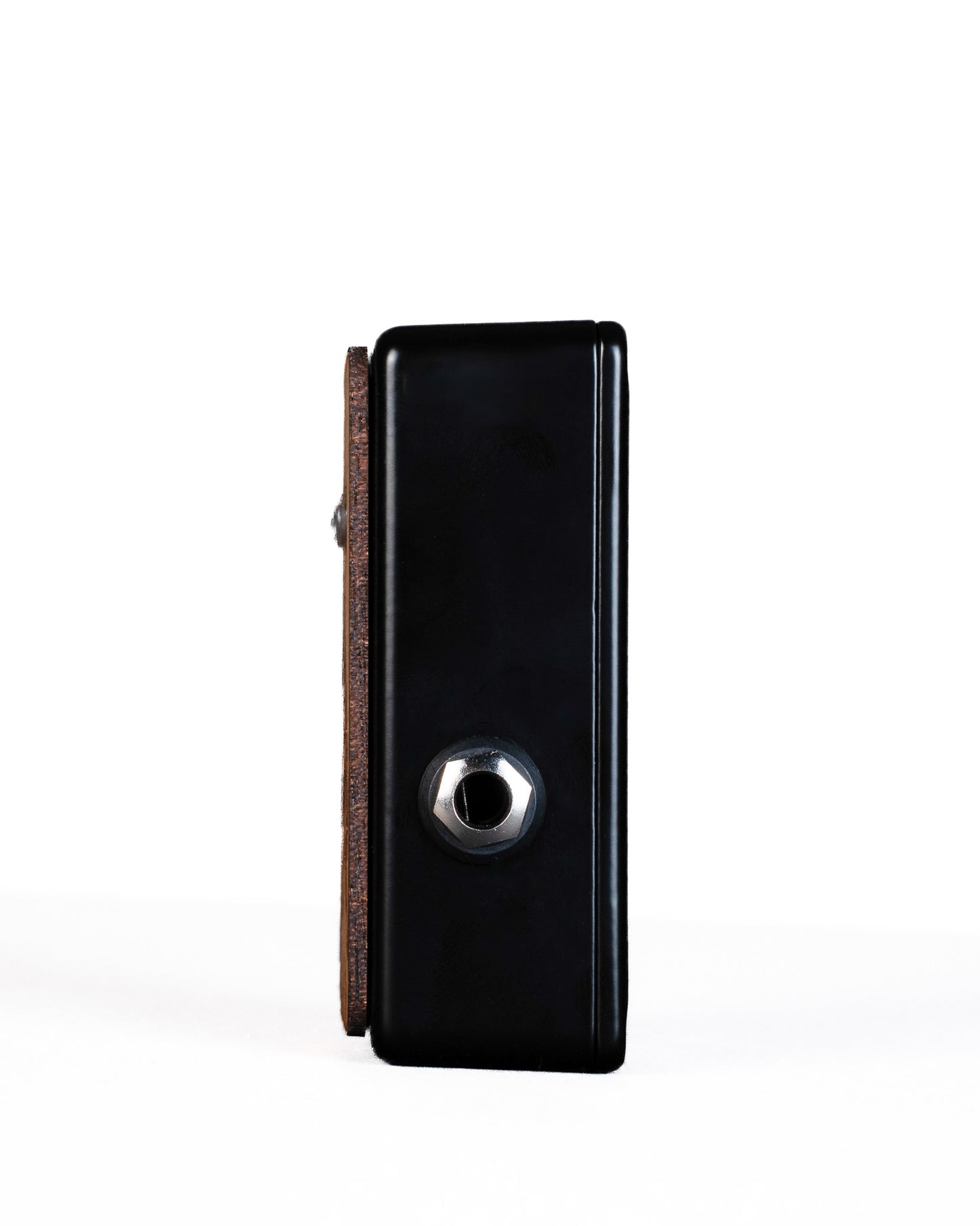
  • Enclosure: mini — 3.64″ × 1.52″ × 1.22″, woodburned tiger face
  • Built: by hand in New Haven, CT
  • Owner's manual (PDF)

Common questions

Do I need to modify my guitar?

No — that's the point. This is the same idea as the buffer built into Tiger, but in a pedal. No routing, no soldering, no surgery on your instrument. First in your chain and you're there.

Does it work with an OBEL rig?

An OBEL version is in the works — the TL061's very low current draw makes it ideal for onboard-effects-loop setups. Join the drop list and you'll hear the moment it's ready.

Where should it go in my chain?

First is the classic spot — it conditions your signal before long cable runs and the rest of your board.

Can I run it at higher voltage?

It's designed for 9V, and that's the spec. Higher voltage is tolerated, but there's no benefit above 9V.

What's the warranty?

Limited lifetime coverage for defects in materials and workmanship. If service is ever needed, most repairs turn around in 7–10 business days.

View full details
Under the hood

Cutler's circuit, kept honest

The unity-gain design from inside Jerry's Tiger — built with low-noise parts that hold their spec instead of drifting out of it.

Nothing to remember

No knobs, no switches. First in the chain, doing its job every second you're plugged in.

Small on purpose

A mini enclosure, about half the footprint of a standard pedal — first in your chain costs you almost nothing on a crowded board.

From the bench

Every Dual Stage pedal gets built, tested and put through its paces on the same bench it was designed on — then backed by our limited lifetime warranty. If it ever quits on you, it comes home and we fix it.

— Donato, Dual Stage Amplification · New Haven, CT